
The Pen: A Human History
The Pen: A Human History
The pen is the simplest of things, a stick with ink in it (or on it). Conceptually unimprovable, its purpose unchanged through the ages, it competes with the wheel, steam engine and microchip as our most important tool of progress. Of all these things, it is the humblest and the cheapest. No other object – not the alphabet, not the printing press, not the book – has accompanied us for so long or communicated so much.
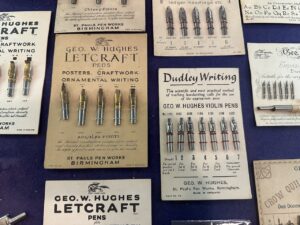
The pen’s ubiquity has also rendered it invisible, or at least unremarkable. There are few memorials in its honour, unless one counts the entire advance of human thought and ingenuity. The pen as silent witness, as embodiment of empowerment; with a pen in your hand, many things seem possible. Diverting the course of history – obviously. Inspirational literary composition – fingers crossed. A tracheotomy at 30,000 feet – bizarrely popular in the movies. Murdering a relative – not unknown. A history of the pen is also a history of civilisation, the technology of the intellect, the handmaiden for the boundless mechanics of the mind. And like Sweeney Todd’s shaving steels, the pen long ago took its rightful place as the natural completion of the arm.
At its broadest level, everything qualifies. The reed is a pen, of course, as is every brushstroke that established calligraphy in Tang-dynasty China. Chalk on the blackboard is a pen, as is every implement that asserted that Kilroy Was Here, every spray can shaken by Keith Haring, every message scratched with a stylus on the walls of Herculaneum before Vesuvius sealed the evidence (‘Two friends were here,’ reads one translated message. ‘While they were, they had bad service in every way from a person named Epaphroditus’). The lump of ochre that cross-hatched a pattern in the Blombos Cave on the Cape coastline of South Africa more than 70,000 years ago (which at time of writing is believed to be the earliest human mark) is a pen. The Apple Pencil is, despite its name, a stick of electronics impersonating a pen. It’s all writing, it’s all tools, it’s all technology. It’s all just us connecting through the years.
Fortunately for us all, this book has a more modest scope. It cannot hope (and does not intend) to sketch such a vast panorama. Rather, this is a testimony and a celebration, a storied anecdotage, a part-lament. I hope to show how the pen became a necessity, an industry, a frustration for the user, a nightmare at the patent office, an obsession for the collector, an affectation for the fogey and a rediscovered pleasure after years pounding the keyboard. My focus begins with quill and ink rather than the flint or stylus; like the reed that composed the codex, the wooden or metal implement that imprinted its trading contracts on clay Babylonian tablets has left us with little prospect of acute or accurate narrative. The book concentrates on the West, the territory I know best. Similarly, I will concentrate on the writing instrument rather than the drawing instrument. The Chinese brushstroke will go unexamined, and except for the celebrity use of the Sharpie, there won’t be much on the felt pen or marker, whose stories are as dull as their tips. The story of the pen at war, by contrast, and the birth and exploitation of the ballpoint, are multi-loop theme park rides.
The book will also find room for creative extravagance (is there a diamond or ruby that Italian pen makers Montegrappa won’t put on a pen?), and there’s space for the absurd (the phallicity of Sigmund Freud’s Montblanc; the existential dilemma of a felt pen in a space rocket). And even if I must jump a moving train in a speedboat to do it, we shall get to the exploding pen in the Bond movies. (Because after all, I hope to show that all pens are potentially explosive.)
Or were. Today one may quite legitimately ask whether one needs a pen at all. Is this book historical document or current affairs? I’ve always loved a hobbyist – their pernickety knowledge, their wonderful compulsions – but pen fairs are surely like stamp fairs and map fairs these days: you won’t meet many teens; you won’t in fact meet many under fifty. The idea of collecting fountain pens when I was young was laughable, like collecting punctured playground footballs. Rather, one would lose them, curse them, discard them as soon as possible for a Biro. I felt the same way from my twenties to my fifties, a period when I collected other things, including records, stamps and maps. But collecting pens is as much about defining one’s past as anything else, and I thought that collecting stories about pens might be an interesting way to examine how the history of this particular technology is safeguarded in our digital world. How is the gold-plated nib explained to a ten-year-old at the Birmingham Pen Museum? How is the fountain pen that signed the peace treaty to end the First World War remembered? How else could Jane Austen, King Charles and Donald Trump be connected if it wasn’t through a shared disquiet with their writing instruments?
Whenever I mentioned the subject of this book to friends, everyone remembered their schooldays. No one thought of ballpoints, everyone thought of fountain pens, the pen they learned to write with and handle prepositions with, the ones made primarily by the defunct and subsumed companies Osmiroid and Platignum that stained their fingers. My friends recalled fountain pens the way they might sherbet fountains: everyone sucked them, they tended not to function very well, and no one missed them when the bell rang (or no more than one might miss the playground bully).
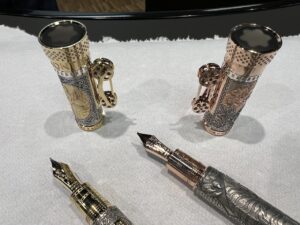
I was wrong about the pen fairs. The ones I attended were not only populated by the excited young – well, those in their thirties and forties, no teens yet – buying back into analogue in a big way (lots of inks and beautiful notebooks alongside the pens). This industry was far from dead, a point emphasised by the spread of Moleskine boutiques and other busy specialist stationery shops in Shoreditch, Le Marais and Nolita. And then there are the most vivid enthusiasms online. Reddit pages and fountainpennetwork.com hum with threads beginning: ‘Fountain pens make me fall in love with writing even more’ and ‘Bought my first real pen at the Philly pen show today!’ Stallholders at the fairs told me that the revival had been visible for a decade or so, and showed no signs of slowing; we were not yet at the level of the vinyl record revival, but getting there.
The global pen industry is slightly larger than the global candle industry (about $18 billion in 2024 compared to the candle’s $14 billion, according to the consultancy company Cognitive Market Research; this is for inky pens alone, with digital pens adding another $5 billion. The forecast is for steady growth.) Pleasingly, pens share other attributes with candles, insofar as they are no longer an essential element of modern living, and inasmuch as they both supply a large soul-enriching element of that early twenty-first century phenomenon known as hygge (for where would journaling be without the whiff of scented soy?)
For me, pen academia effortlessly turns to pen consumerism. Beyond its history, and beyond its utility, a well-balanced pen is just a beautiful thing to hold in the hand. To buy one – even something as factory-turned as the Lamy Safari – is to experience the most affordable fulfilment. By the end of my visit to the spectacular Montblanc Haus in Hamburg, I was almost convinced that a fountain pen was an essential tool for life. The truth is otherwise. No one – not even a president signing themselves into office or Charles III signing himself into the Kingdom – needs a Montblanc fountain pen, much less one where the price starts at £555 and goes crazy from there. A Bic Cristal will do: 26p each if you buy a box of fifty. Also, a Bic is a good chew, and its cap a good ear-scratch, and it was once fantastic at winding cassettes. How we got to the 26p pen – that too is the focus of this book.
These days, of course, our pens are losing out to our phones. Digital hardware and AI will forever be finding more powerful and lucrative ways to make us tap on keyboards and glass. The simple pleasures that return when we resist – the unique adhesion of ink to paper, our slower cerebral flow – may be occasionally upended by the realisation of how terrible our handwriting has become (it was never great, but now…). There is something very disappointing about my bitten fingernails when I use a well-crafted pen, as if I’m betraying a perfect habit with a bad one. But the happiness I derive from writing in my notebook, and the rare thrilling zither of a handwritten letter dropping through the door, transcends the embarrassment. We have not lost this art, despite the allures of the iPad and the folding phone.
Before mass digital communication suggested the game was up (erroneously, the mood suggests), pen companies used to advertise their wares with fantastical claims. They had to: how else to stand out in a market where everyone was essentially selling the same thing? So Waterman nibs apparently wrote for thirty-eight miles before signs of wear. Sheaffer made ‘the world’s only pen scientifically streamlined for Balance’. Eversharp asked people to ‘imagine a pen not much longer than your cigarette . . . so precision-fashioned that you can write at any angle!’, and they paid Humphrey Bogart to endorse it. These days, the tone has shifted. The companies that have survived are as much concerned with promoting the idea of the pen and the pen’s potential.
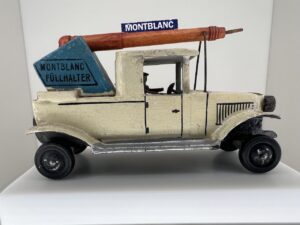
Montblanc wishes to ‘Inspire Writing’. Parker wants us to ‘Be the Author of Your Own Success’, and asks ‘Is your life going to be poetry or prose?’ ‘While other pens just write,’ Parker’s great competitor claims, ‘Waterman expresses.’ Even at Bic, a mission statement from 2025 emphasises its ‘mission to celebrate creativity and freedom of expression’. The focus is on analogue humanity, the tactile pleasures. Without them, an object that was once essential might go the way of the Georgian horse carriage. Like vinyl records and the revival of heritage railways, those who still love the pen maintain an unshakable conviction that the old stuff is just better for the soul. The plastic box of the word processor (and its sister brain processor, the internet) is a brilliant substitute for the daily pen, but it only requires our fingertips, and that’s good for shaking hands. Increasingly we seem to be returning to the embedded warmth of human connection.
One finds solace in unexpected places. In 2000, upon completing his novel Dreamcatcher, Stephen King wrote an afterword. He had written too many previous works on a keyboard, he reasoned, and so ‘This book was written with the world’s finest word processor, a Waterman cartridge fountain pen. To write the first draft of such a long book by hand put me in touch with the language as I haven’t been in years.’ And in the preface to the first part of his presidential memoir A Promised Land, Barack Obama wrote that he had written his first draft on yellow legal pads with a Uni-ball Vision Elite rollerball with a 0.5mm micro-point (about $2 each when bought in bulk). ‘I still like writing things out in longhand,’ he explained, ‘finding that a computer gives even my roughest drafts too smooth gloss and lends half-baked thoughts the mask of tidiness.’
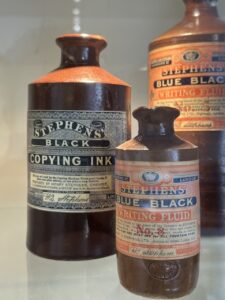
All writers, like all civilisations, tend to progress with the improvement of their tools. The pen in all its forms has always dictated the speed and rhythm of writing, and perhaps the speed and rhythm of thought itself. Literary fluency has always struck a bargain between intellectual intention and practical possibility, and progress has usually been fuelled by irritation. The quill and all its faff – the hardening, the cutting, the dipping – necessarily slowed the hand. The steel-nibbed dip pen still needed constant dipping; sentences were interrupted mid-flow. The fountain pen eradicated the ink storage problem but not the need to blot or prevent leakage, while the ballpoint cleaned everything up. The technology of the pen not only coincided with the growth in literacy but facilitated it, while improvements in ink production and reliability ensured that the product of that literacy endured.
For all the joy I derive from holding and using a pen, I’m aware that an object five or six inches long can be an obstinate thing to describe, not to say a tedious one. Let me rephrase that. To most people a pen is a pen is a pen. For those for whom this isn’t the case – the aficionados online, the engineers and jewellers who labour for months on elaborate limited editions – no description of a pen will suffice. So in the pages that follow I’ve tried to answer the broadest questions, and to locate the best stories, and place them as much as possible within a human framework. What are the key turning points in the history of the writing instrument and what are the most diverting ones? What did Virginia Woolf and Julian Barnes think of their pens? Why is the Parker 51 regarded as the best pen ever, not least by Parker? How are pens occasionally involved in acts of violence, sometimes deadly? And what is it like inside the Bic factory in Marne-la-Vallée? (It is loud and fantastical, a perfect plastic companion to Disneyland Paris next door.)
Is the pen the object in our lives we lose and borrow most often? Why might this be? I would keep a precious pen on my desk, and put it in a case when travelling, and even with due care I would lose it many more times than I have lost keys, phones, books or even coins. Sometimes precious pens would turn up months or years later, and they hadn’t travelled far – the bottom of a bag, the edge of a drawer. A couple of lines and they would write as they always had, even the fountain pens. And then a few weeks later they would go travelling again. So they are mislaid rather than lost, a period of absence built in, a sabbatical. And if they are lost, so what? It’s our indifference that keeps the ballpoint industry afloat and the oceans full of plastic.
There is no word for the study or collection of pens – no equivalent of philatelist or numismatist or oenologist or palaeontologist. You are a penman or penwoman, a penologist, a penthusiast, a pencase (like a nutcase), but your hobby has not made it into the dictionary. This will be of little concern to those who wait, silently salivating, for the sequel to the masterly 364-page Smaller English Pen Makers 1890–1930: A Comprehensive Guide by Stephen Hull and Andy Russell. Most of these people could identify every make of patented feeder system, and fix them when misshapen. In fact, they’d relish the task. The fact that the expert knowledge of the pen connoisseur is occasionally beyond me is something I find oddly reassuring. A back issue of the Journal of the Writing Equipment Society from Winter 2019 has an article on how to repair a cap lip of a Swan eyedropper with a wire feed using a liquid weld landing area on a hand-turned lathe. This book is not for that person. It is, rather, for anyone who ever gazed longingly at the pen cabinet in the shop Choosing Keeping in Covent Garden, and departed £80 lighter with their lives newly enriched.
Extraordinary. Timeless, funny and utterly absorbing.